Submerged Arc Welding
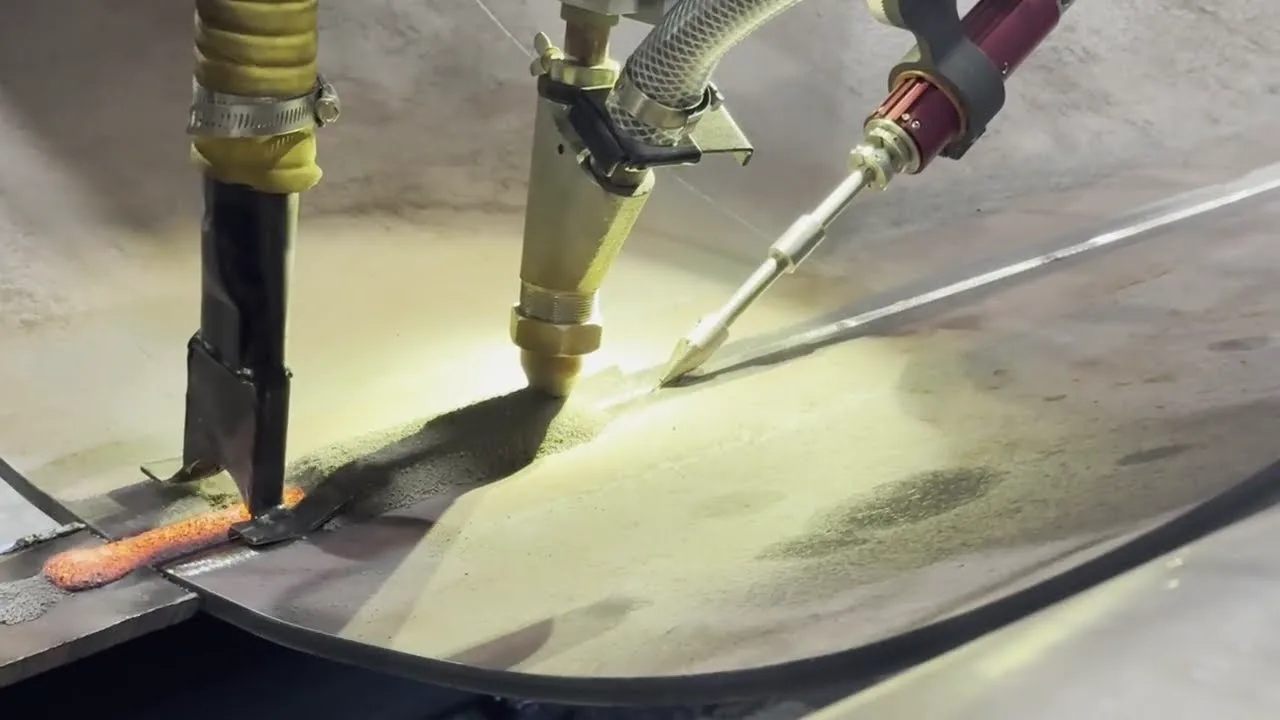
Submerged arc welding, or SAW, is how we weld the long seams and round seams on our pressure vessel shells and storage tank cans here at Ramco. The arc runs under a blanket of granular flux, so it lays down a deep, consistent weld faster than any hand process can on heavy plate. Watch it in action below!
How Submerged Arc Welding Works
A continuous wire feeds through the welding head while a hopper lays a bed of granular flux on the joint just ahead of it. The arc burns underneath that flux, which is where the process gets its name. There is no visible arc, almost no spatter, and very little smoke. The flux closest to the arc melts into a slag that shields the weld as it cools, and the rest is vacuumed up and reused.
Because all of that heat stays buried in the joint, submerged arc gets deep penetration and deposits a lot of metal per pass. A seam on heavy plate that would take a welder several passes by hand often goes in one or two, and every inch of it is laid at the same travel speed and the same wire feed, from the start of the seam to the end.
Where We Use It
Submerged arc is our process of choice for the seams that make up a vessel or tank shell:
- Long seams on shell cans that come off our plate rolls, like the buffer tank in the video.
- Circumferential seams that join cans to each other and to the heads, with the shell turning on rolls under the welding head.
Why It Matters for Your Vessel
- Consistent, full-penetration welds. The machine holds the same settings down the whole seam, so you get the kind of uniform, sound weld that Code inspection calls for, without the stops and restarts of hand welding.
- Faster seams, better pricing. High deposition rates mean the long seams on a big shell take hours instead of days, and that shows up in both the lead time and the quote.
- Qualified to ASME Section IX. Our submerged arc procedures are qualified the same way as every other welding process we put on a "U" stamped vessel, so there is no difference in the paperwork.
- A clean, flat bead. Submerged arc welds come out smooth, with no spatter to clean up, which means less grinding before the vessel goes to sandblast and paint.
Frequently Asked Questions
What is submerged arc welding?
It is an automatic arc welding process where the wire, the arc, and the molten weld pool are all covered by a layer of granular flux. The flux shields the weld from the air and keeps the heat in the joint, which gives deep penetration and a high deposition rate. It is the standard process for long, straight, and round seams on heavy plate.
Do you weld everything with submerged arc?
No. Submerged arc needs a seam the head can travel along in the flat position, so we use it on the long and circumferential seams of shells. Nozzles, attachments, repairs, and anything that cannot be positioned are welded by hand by our certified welders.
Does it meet ASME Code?
Yes! Our submerged arc procedures and operators are qualified to ASME Section IX, and we use the process on the "U" stamped vessels we build and register with the National Board every day.
Can you weld shells that we rolled ourselves?
Yes! Send us your rolled cans and we will fit and weld the seams. If you would rather we roll them too, our plate rolling department handles plate up to 1-1/4 inch thick and 10 feet wide.
We will gladly prepare a customized quote for you.
Request a Quote